Op. Dr. Bora Yücel

Breast Augmentation in Turkey, Antalya
The breasts are one of the main features that define the female silhouette. Its rounded shape creates more curved body lines, emphasising the narrowness of the waist and balancing the convex curves of the hips.
The female breast has represented various emotions in our subconscious. Undoubtedly, the most significant of these is its association with motherhood and fertility. As it nourishes the baby after birth, the breast inherently symbolises compassion, fertility and love, even if we are not consciously aware of this. Throughout history, many civilisations have glorified women for this attribute of fertility, often depicting the breast in sculptures celebrating womanhood.
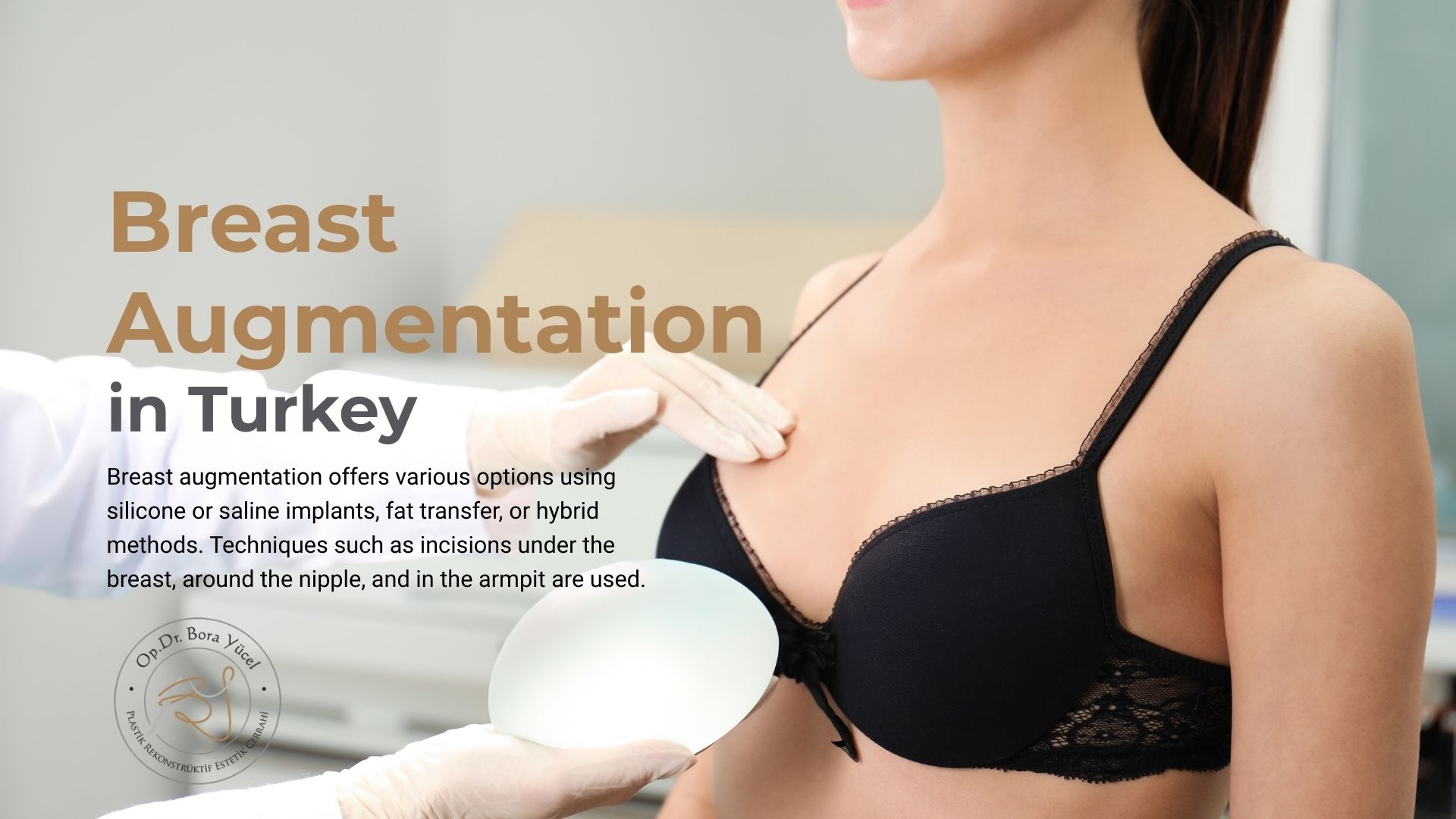
Breasts begin to develop during puberty in girls, marking the transition to womanhood and symbolising sexual maturity. Today, beyond these instinctive mental associations, many of us simply wish to achieve body proportions that are considered beautiful or desirable by modern standards. For those seeking to achieve their desired breast size through augmentation, we will explain the procedure in detail.
What is Breast Augmentation?
Breast augmentation is a cosmetic surgical procedure that involves enlarging or reshaping the breasts. This aesthetic operation can be used to achieve a larger breast structure. Those unhappy with the shape of their breasts may also opt for this procedure. Sagging or misshapen breasts can be made to look more attractive. This can boost patients' confidence. The desired breast shape depends on the individual's aesthetic goals and anatomical suitability.
Some women may require this procedure due to asymmetry between the two breasts. This procedure can achieve shapely, symmetrical breasts.
Breast augmentation can reshape breasts that have become deformed or asymmetrical due to genetic factors, ageing, or environmental factors such as childbirth. It is also recommended for women who want to enlarge their breasts.
There are two ways in which breast augmentation can be performed. The first method involves placing implants in the breasts to improve their shape and, optionally, their size.
The second method uses fat transfer to achieve the desired breast shape and size.
Your plastic surgeon will determine the most suitable treatment method for you.
How is breast augmentation performed?
Preliminary examination:
First, you need to schedule an appointment with your chosen surgeon. During your initial consultation, you should describe in detail any issues you are experiencing with your breasts, as well as your desired breast profile. You should also inform your doctor of any chronic illnesses, previous surgeries and other important aspects of your health history. Based on this information, your doctor will proceed with your examination.
At this stage, your surgeon will take measurements of your breasts. They will assess the position of the nipple, breast dimensions and skin elasticity. If necessary, some blood tests and imaging scans may also be requested. Based on this data, your doctor will present you with a treatment plan and the available options. The options you may encounter include:
- Type of implant: Saline or silicone
- Desired breast size
- Implant shape: Teardrop or round
- Implant placement area: Under the muscle or over the muscle
With your surgeon’s guidance, you can decide which of these options is ideal. However, in some cases, certain choices may be necessary due to medical requirements.
Based on these decisions, your surgeon will determine where to make the incision. Depending on what is needed, the incisions may be made in the armpit, under the breast or around the areola.
Surgical operation:
The patient is given general anaesthesia prior to this operation. The procedure typically lasts 1–2 hours and the patient does not feel any pain or discomfort during this time. The surgeon makes a small incision in the previously identified appropriate area. A pocket is then created in the area where the implant will be placed. The implant is then inserted into this space. The position of the implant is then adjusted until the desired symmetrical appearance is achieved. Once the implant is in the correct location, the placement process is complete. The incisions are then closed with aesthetic sutures. A bandage is then applied.
Post-operative:
After the operation, the patient may be discharged on the same day, or they may be asked to stay in hospital for observation for one day. The stitches will usually dissolve during the healing process, so they do not need to be removed. It is important to attend follow-up appointments within the recommended timeframe. This enables the results of the procedure to be properly evaluated.
What is the difference between silicone and saline implants?
As previously mentioned, the type of implant used for breast augmentation can vary. This choice can depend on the patient’s condition and desired breast appearance. We will now explain the differences between the two types of implant.
Silicone Implants:
These implants are made of silicone. They have a gel-like consistency and a smooth texture that closely resembles the natural softness of breast tissue. Deformation may be difficult to detect, which is why regular check-ups with a doctor are recommended. A slightly larger incision may be needed for placement. Due to their natural appearance and texture, silicone implants are the most popular choice.
Saline Implants:
Saline implants are primarily filled with a saltwater solution. They feel firmer and fuller. Any deformation is easily noticeable due to a visible decrease in volume. They can be inserted through a small incision as the filling is done after placement. They are not the most preferred type of implant since they feel less natural. However, they are more cost-effective.
What is the difference between submuscular and supramuscular breast implants?
Now, let's look at the differences based on where the implant is placed. There are actually three different placement areas. The area selected should be based on skin elasticity, the desired shape and body structure. In other words, depending on your physical features and the desired shape, the location of the implant placement may vary. Breast implants can be placed under the muscle, over the muscle, or partially in both areas using the dual plane technique. We will now explain the differences between these implant placements in detail.
Submuscular Implant:
Also known as submuscular placement, this type of implant is positioned just beneath the chest muscle. Compared to implants placed over the muscle, it provides a much more natural-looking result. It does not interfere with clear imaging in mammograms, which women are advised to undergo regularly for breast cancer screening. During the initial recovery period, it may cause slightly more pain than an operation where the implant is placed over the muscle. However, it tends to sag less over time. However, due to muscle movements, shifting of the implant may occur.
Subglandular Implant:
In the subglandular implant technique, also known as subglandular placement, the implant is placed under the breast tissue and directly above the chest muscle. If the breast skin is thin, the implant may be noticeable. As the implant is in the breast area, mammogram images may not be as clear as desired. Recovery tends to be faster after surgery compared to submuscular placement. However, there is a higher risk of sagging breasts over time.
Dual Plane Technique:
This special placement method involves positioning the upper part of the implant under the chest muscle and the lower part under the breast tissue. In other words, it combines the two techniques described above. The chest muscle covers the top of the implant while the breast tissue supports the bottom. This combination provides a more natural-looking transition. It does not interfere with mammographic imaging. The risk of complications such as hardening is significantly lower. Typically, there is no risk of long-term breast sagging.
Who is good for Breast Augmentation?
Now, let's address the question of who is a suitable candidate for breast augmentation.
Breast augmentation is appropriate for:
- Individuals with small breasts who are not satisfied with their appearance,
- Women whose breast volume has decreased due to significant weight loss, breastfeeding or pregnancy,
- Women with noticeable asymmetry between their breasts who are unhappy with it,
- Women who have had a mastectomy due to health issues and wish to reconstruct their breast,
- Individuals who want to enlarge their breast size to create a more proportionate body silhouette,
- Individuals aiming for curvier body contours,
- Individuals without serious chronic health issues that would prevent surgery,
- Individuals over the age of 18 who have completed their physical development.
Who is not suitable for Breast Augmentation?
Unfortunately, even if requested by the patient, plastic surgeons may not deem breast augmentation surgery appropriate in some cases. In such situations, the physician may offer alternative suggestions. Let’s now explain the conditions in which breast augmentation surgery is not considered suitable:
- Individuals with cardiovascular diseases, uncontrolled diabetes, clotting disorders or advanced immune system disorders may not be considered suitable candidates for this surgery.
- Breast augmentation is also not recommended for women who are pregnant or breastfeeding. After pregnancy and breastfeeding, it is necessary to wait for the breasts to return to their final shape. Please note that the milk glands, milk ducts and other glands beneath the breast undergo temporary changes in form and size during and after these stages. This process must be completed before the breast augmentation procedure can be performed.
- If an individual has an active infection or conditions such as breast cysts, these must be treated before surgery. The operation should not be carried out until complete healing is achieved.
- Individuals requesting the procedure should not have a distorted body image. Their expectations of the surgery must be realistic and achievable.
- Heavy substance use or addiction can negatively affect the healing process. These dependencies should be reduced beforehand and, if possible, stopped completely.
- The procedure should not be performed on individuals who have not completed their physical development.
- People with severe allergies must inform their doctor. If the allergy poses a significant risk, the operation may not go ahead.
Is there an age limit for Breast Augmentation?
Yes, there is an age limit for breast augmentation surgery. This varies from country to country, depending on local regulations. According to the U.S. Food and Drug Administration (FDA)'s recommendations, the age limit for breast augmentation is:
- 22 years old for silicone implant surgeries.
- 18 years old for saline implant surgeries.
In Turkey and many other European countries, the age limit is 18.
There are, of course, rational reasons for this age restriction. It is expected that breast tissue, skin structure and rib cage development will be complete. Otherwise, an operation performed under current conditions may not be compatible with the body once development is complete.
In children and adolescents, hormonal levels have not yet stabilised. Therefore, growth is ongoing and both size and form continue to change.
Individuals who have not yet reached adulthood may regret decisions they make in the heat of the moment. For this reason, they must be psychologically and physically mature enough to make such a decision.
However, this may vary in cases of special health conditions, if deemed appropriate by the surgeon.
What are the risks of Breast Augmentation?
As with any surgical procedure, breast augmentation carries certain risks. Although these risks are minimised through the use of modern materials and testing to determine patient suitability after the initial consultation, as well as proper application methods, some complications and undesired outcomes may still occur. Anyone considering the procedure should be aware of these risks and make their decision accordingly. The risks associated with breast augmentation are as follows:
- If the body does not accept the implant and perceives it as a foreign object, it may form a hard capsule around the implant. This can lead to problems such as deformity and asymmetry. This condition is known as capsular contracture.
- Silicone and saline implants may deform and leak. Saline implants may shrink due to leakage, making the issue more noticeable. However, leakage from a silicone implant is more difficult to detect. For this reason, regular MRI screenings are recommended.
- As with any surgical procedure, there is a risk of infection with breast augmentation. Infections usually occur within the first few weeks. In severe cases, removal of the implant may be necessary.
- Internal bleeding caused by damage to the blood vessels may result in swelling and bruising. Although rare, a second operation may be required to clean up the bleeding.
- If the surgery is not performed by a professional, asymmetry or an undesirable breast shape may result. In such cases, a second operation may be necessary.
- Temporary or permanent loss of sensation, or an increase in sensation, in the nipple or surrounding area may be experienced.
- Implant displacement may occur.
- Due to genetic predisposition, scarring may become more pronounced in some individuals.
- A rare type of lymphoma known as BIA-ALCL may develop. Although extremely rare, implants have been associated with lymphoma in some cases.
How many breast sizes can be enlarged with Breast Augmentation?
The extent to which the breasts can be enlarged through augmentation surgery depends entirely on the individual. The patient’s height-to-weight ratio, preoperative breast shape and size, skin elasticity, chest structure, desired breast shape, skin thickness and implant placement are all factors that play a role. The average implant volume required for a size increase is approximately:
- 150–200 cc for an increase of half to one cup size
- 250–300 cc for an increase of one to one-and-a-half cup sizes
- 350–400 cc for an increase of two cup sizes.
As mentioned above, these figures can vary depending on the individual’s anatomical structure and desired breast shape. Extremely large breasts may lead to back and waist pain. In addition, large volume changes may result in an unnatural appearance.
Does Breast Augmentation look natural?
Breast augmentation can achieve a very natural appearance. However, this outcome depends on certain factors. These are:
- The correct implant must be selected. You should choose an appropriately sized implant that is not overly large. If you choose a size that is significantly larger than your existing breast volume, it will be more difficult to achieve a natural look. The implant should also match your breast shape. Generally, teardrop-shaped implants can provide a more natural appearance.
- The placement of the implant should be chosen according to your anatomy and lifestyle.
- We recommend having the operation performed by a specialist, experienced surgeon. This will help ensure more natural and flawless results.
- The more breast tissue, volume and skin elasticity you have, the more natural the results will be.
What is the recovery process after Breast Augmentation?
Post-operative expectations can vary depending on the scope of the operation and the individual. However, the general recovery process is as follows:
First three days:
Pain and swelling may occur. This condition, caused by oedema, can be managed with the medication prescribed by your doctor. You may experience limited movement in the areas near your chest and arms due to pain. You should wear the support bra recommended by your doctor. The incision area should be kept clean and dry.
First week:
During the first week, you can return to your normal routine, provided you avoid strenuous activities. The swelling will have decreased to a certain extent. However, the breast has not yet settled into its final position. You may still experience a certain level of tightness.
Weeks 2–6:
Swelling significantly subsides. Your body will begin to adapt to the implant. The breast begins to take on a more natural appearance. You may start light exercises with your doctor’s approval.
After week 6:
The breast will have reached its natural appearance. Softer tissue develops. Incision marks will have faded significantly. You can fully return to your daily routine.
However, it’s important to attend follow-up appointments at the intervals recommended by your doctor during this period and to follow all post-operative care instructions thoroughly. Taking the necessary precautions recommended by your doctor will help you to achieve the desired results.
How many times can Breast Augmentation be performed consecutively?
It is medically possible to undergo breast augmentation two or even three times. The operation may be repeated due to implant replacement, complications or dissatisfaction with the shape achieved. However, each additional surgery can affect tissue quality, increase the risk of complications and lead to more noticeable scarring.
Can the baby be breastfed after Breast Augmentation has healed?
Many women are able to breastfeed after undergoing breast augmentation. However, if this is your intention, you should discuss it with your surgeon so that the procedure can be planned accordingly. Although rare, implants placed beneath the breast tissue may compress the milk ducts. Therefore, submuscular placement is often recommended for women who plan to breastfeed in the future.
Incisions around the areola may irritate the milk ducts and, for this reason, may not be recommended for women planning a pregnancy. The type of implant used does not affect the quality of the breast milk produced. Studies have shown that the amount of silicone a baby receives from a mother with breast implants is significantly lower than the amount absorbed through a baby bottle.
What should be considered when choosing a clinic and physician for Breast Augmentation?
First and foremost, you should choose a doctor who is a specialist in plastic, reconstructive and aesthetic surgery. It is particularly important that they have specific experience in breast implants. We therefore recommend reviewing before-and-after images of breast augmentation surgeries performed by the surgeons on your shortlist, which can typically be found on their social media platforms and websites. You should also carefully read patient feedback and reviews on these platforms and on Google. These evaluations will give you insight into the surgeon’s success rate and surgical style.
Ensure that the clinic where the surgery will be performed meets international standards by reviewing its certifications, and request documentation proving that the clinic is approved by the respective country's health ministry.
Membership of international associations may indicate that the surgeon keeps up with current advancements. ISAPS and ASAPS are among the leading organisations in this field.
Your surgeon should prepare a treatment plan that is entirely tailored to you and your specific conditions. They should provide thorough information about the process and answer all your questions in a rational manner. You should feel comfortable expressing yourself honestly with your doctor in a safe environment.
The clinic where the surgery takes place should have the necessary technology and technical infrastructure, and should meet high hygiene standards.
Before signing, you must read the informed consent form and contract carefully, and avoid signing any clauses that are not suitable for you.
Frequently Asked Questions
Does a scar remain after breast augmentation surgery?
Yes, scars usually remain. However, incisions are made in the least visible areas to minimise their appearance. Over time, these scars heal and fade in appearance. The extent of scarring can vary depending on an individual's skin structure, the surgical technique used and the surgeon's expertise.
Is breast augmentation surgery an obstacle to breastfeeding?
In most cases, it does not prevent it. However, the technique used and the surgeon's expertise can make a difference. Therefore, if you are planning a pregnancy, it is important to inform your doctor. This allows the location of the incision and the placement of the implant to be chosen differently, thereby reducing the risk.
How to decide on breast size?
This decision depends on a variety of factors, including a person's personal aesthetic preferences, the structure of their rib cage, their breast size, their skin thickness and elasticity. Your surgeon should also present the available options in accordance with your health and lifestyle. You will be shown the breast shapes and sizes you can achieve before the operation using 3D simulations and various software tools. With your surgeon’s guidance, you can then decide on the most suitable form and size.
Please contact us for more information.